


Understanding mobility in individuals with cerebral palsy is essential for creating effective therapy plans, determining appropriate support, and tracking progress over time. One of the most widely used tools to assess mobility is the Gross Motor Function Classification System (GMFCS). This system provides a standardized way to describe the gross motor function of children and adults with cerebral palsy, allowing healthcare professionals, therapists, and families to communicate clearly about abilities and limitations.
What is GMFCS?
The GMFCS is a classification system that categorizes gross motor function into five levels, ranging from Level I, indicating the least severe limitations, to Level V, representing the most significant mobility challenges. The system focuses on self-initiated movement, particularly sitting, walking, and wheeled mobility. By using GMFCS, clinicians can better understand an individual’s current functional abilities, predict future mobility outcomes, and plan interventions accordingly.
The GMFCS is age-specific, with descriptions tailored for children under two, children between two and four, and older children and adults. This ensures that the assessment accurately reflects developmental expectations at different stages of life.
GMFCS Levels and Mobility
Each GMFCS level provides insight into the functional capabilities and support needs of a person with cerebral palsy:
- Level I: Individuals can walk independently and perform most gross motor skills without limitations. While they may experience mild difficulties with balance or coordination, they do not require assistive devices.
- Level II: Walking is possible without devices, but mobility may be limited in more challenging environments, such as uneven terrain or crowded spaces. Individuals may need support for prolonged walking or running.
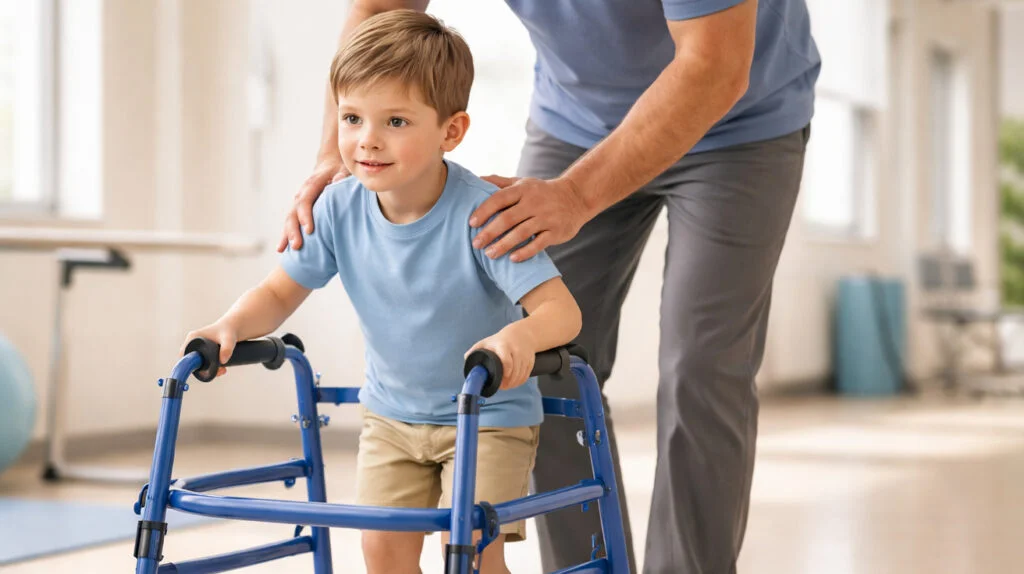
- Level III: Walking requires the use of hand-held mobility devices such as walkers. Independent movement is possible for short distances, but assistance may be necessary in many situations.
- Level IV: Self-mobility is severely limited. Individuals often rely on powered mobility or require extensive physical support for daily movement. Walking may not be functional, and long distances typically necessitate a wheelchair.
- Level V: Individuals have the most severe limitations in self-mobility. Manual control and walking are minimal or absent, and individuals typically require assistance for all movement-related activities.
By categorizing individuals in this way, GMFCS allows clinicians to clearly communicate about mobility potential and limitations, as well as to monitor changes over time.
Importance of GMFCS in Therapy and Care Planning
Using GMFCS is crucial for developing individualized therapy plans. For example, children classified at Levels I or II may benefit from targeted physical therapy to enhance strength, endurance, and coordination, while those at Levels IV or V may require a combination of assistive technology, wheelchair training, and caregiver support.
GMFCS also helps guide decisions about adaptive equipment. Mobility aids, orthotics, or powered wheelchairs can be selected based on the functional abilities indicated by the GMFCS level. This ensures that interventions are appropriate, safe, and aligned with the individual’s current and future needs.
Predicting Outcomes and Planning for the Future
The GMFCS is not only a tool for current assessment but also for predicting long-term outcomes. Research shows that early GMFCS classification can help anticipate mobility abilities later in life. For instance, children classified at Level I or II are more likely to maintain independent walking into adulthood, while those at Levels IV or V will continue to rely on wheeled mobility.
Understanding these trajectories allows families, educators, and therapists to plan ahead for educational accommodations, adaptive equipment, and home modifications. It also provides realistic expectations about mobility milestones and long-term care needs.
Tracking Progress Over Time
The GMFCS is valuable for tracking changes in gross motor function over time. Regular assessments can identify improvements due to therapy, interventions, or growth, as well as declines related to secondary complications such as joint contractures or muscle weakness.
Tracking GMFCS levels longitudinally helps guide ongoing therapy and ensures that the individual receives the right type and intensity of support at each stage of development. It also facilitates communication between multidisciplinary teams, making it easier to coordinate care across healthcare providers, schools, and family members.
Enhancing Communication Among Care Teams
By using GMFCS, healthcare professionals have a common language to describe mobility levels. This standardization is especially useful when working across multiple disciplines, such as physical therapy, occupational therapy, orthopedics, and educational support. It ensures that all team members understand the individual’s abilities, limitations, and therapy goals, leading to more coordinated and effective care.
Families also benefit from understanding GMFCS, as it helps them recognize their child’s functional abilities and support needs. Awareness of GMFCS levels can empower families to advocate for appropriate services, make informed decisions about equipment and interventions, and support their child’s independence in daily life.
Conclusion
The GMFCS is an essential tool for understanding mobility levels in individuals with cerebral palsy. By classifying gross motor function into five levels, it provides a clear framework for assessing abilities, predicting outcomes, and planning therapy and support.
From guiding individualized interventions to selecting adaptive equipment and monitoring progress, GMFCS plays a central role in improving quality of life for people with cerebral palsy. Its use enhances communication among care teams and families, ensures that support is tailored to the individual, and helps set realistic expectations for mobility and independence.
Overall, the GMFCS offers a structured, reliable, and practical approach to understanding and supporting mobility in cerebral palsy, helping individuals achieve their maximum potential and participate more fully in daily life.
Want more to read? Visit dDooks.
