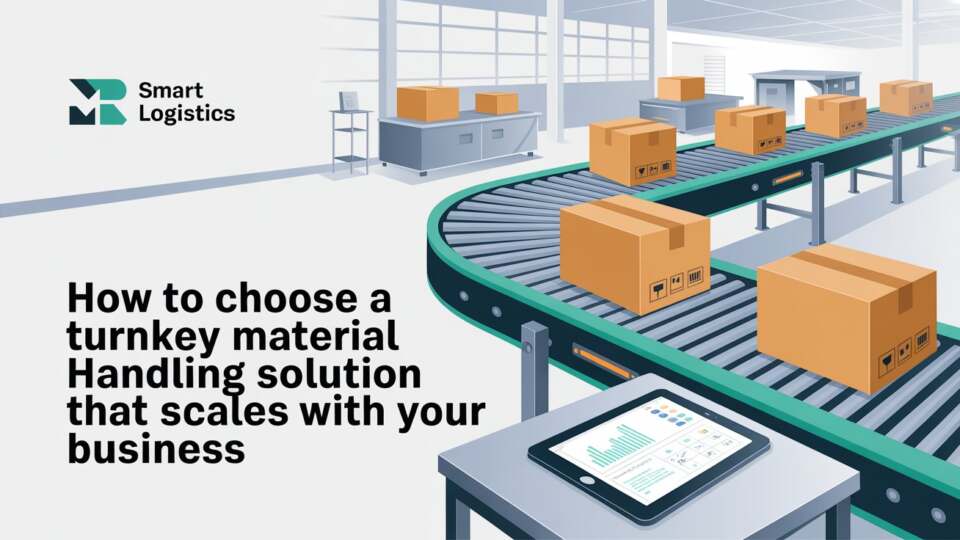
Every growing business faces the same challenge: how to move goods, materials, and products faster without losing accuracy or safety. Whether it’s a warehouse, manufacturing plant, or distribution center, the way materials are handled directly affects productivity and profit. That’s why many companies are turning to turnkey material handling solutions. A turnkey system combines conveyors, robotics, storage systems, and warehouse management software (WMS) into one integrated setup. The advantage? It’s designed, built, and installed as a complete package, tailored to your operation. But choosing the right solution isn’t always simple. It requires looking at efficiency, cost, safety, and scalability. This article breaks down the common problems businesses face and how to pick a turnkey material handling system that grows with your needs.
Improving Efficiency in Warehousing
Problem – Manual Processes Slow Down Operations
In many facilities, staff still pick and move products by hand. This creates bottlenecks, delays, and higher error rates in order fulfillment.
Solution – Automated Systems for Speed
With automated conveyors, robotic arms, and sorting systems, a turnkey solution speeds up workflow. Goods move smoothly from storage to shipping, reducing downtime and increasing order accuracy.
Reducing Labor Costs and Errors
Problem – Heavy Reliance on Manual Labor
Manual lifting, stacking, and transporting add labor costs and increase the risk of mistakes. More staff doesn’t always mean better results.
Solution – Robotics and Smart Equipment
Material handling robots and automated guided vehicles (AGVs) can do repetitive tasks more accurately and safely. This reduces errors, keeps costs under control, and allows employees to focus on higher-value tasks.
Do Read: Why Growing Businesses Are Leaving In-House IT Behind for Managed Services and Cloud Technology
Streamlining Manufacturing Operations
Problem – Bottlenecks in Production Lines
Production often slows when raw materials aren’t delivered to workstations on time or finished goods pile up waiting for transfer.
Solution – Integrated Flow Systems
Turnkey handling solutions connect every stage of production with automated lifts, conveyors, and storage racks. This keeps production moving smoothly, ensuring that supply matches demand.
Enhancing Safety and Compliance
Problem – Workplace Injuries From Manual Handling
Heavy lifting and repetitive motion lead to injuries, higher insurance costs, and downtime.
Solution – Ergonomic and Automated Designs
Turnkey systems use ergonomic lifts, conveyor belts, and robotics to minimize manual handling. They also help meet OSHA safety standards and reduce accident risk.
Ensuring Scalability for Growth
Problem – Legacy Systems That Can’t Expand
Many older material handling setups work fine until demand spikes. Then they fail to keep up, causing missed deadlines and lost opportunities.
Solution – Modular and Scalable Designs
A good turnkey solution is built with scalability in mind. Modular conveyors, expandable storage systems, and software upgrades allow businesses to add capacity without replacing the entire system.
Leveraging Technology and Data Insights
Problem – Lack of Visibility in Operations
Without accurate data, it’s hard to know where delays, inefficiencies, or errors are happening in the system.
Solution – AI and Real-Time Analytics
Modern turnkey solutions include AI-driven analytics, smart sensors, and WMS platforms. These tools provide real-time tracking of inventory, predict demand, and highlight inefficiencies. With this visibility, managers can make data-driven decisions.
Balancing Cost and Long-Term ROI
Problem – High Upfront Costs
Some companies avoid turnkey systems because of the initial investment. They worry the cost outweighs the benefits.
Solution – ROI Through Efficiency and Savings
Turnkey material handling solutions save money over time. They reduce labor costs, improve accuracy, and prevent losses from damaged goods. Over the long run, they deliver a higher return on investment (ROI) than piecemeal systems.
Simplifying Logistics and Setup
Problem – Complex Installs and Downtime
Integrating different vendors and equipment often leads to delays and compatibility issues.
Solution – Complete Turnkey Integration
Because turnkey systems are delivered as a single package, installation and training are streamlined. Businesses get one point of contact, faster setup, and less downtime.
Conclusion
Choosing the right turnkey material handling solution is about more than just adding conveyors or robotics. It’s about creating an integrated system that improves efficiency, reduces costs, enhances safety, and adapts as your business grows. By focusing on automation, scalability, real-time analytics, and modular designs, you can avoid common pitfalls and build a system that works today and evolves for tomorrow. The right turnkey solution isn’t just an expense—it’s a long-term investment in productivity, safety, and growth. When your material handling scales with your business, you’re not just moving products—you’re moving your company forward.
Want more to read? Visit dDooks.