


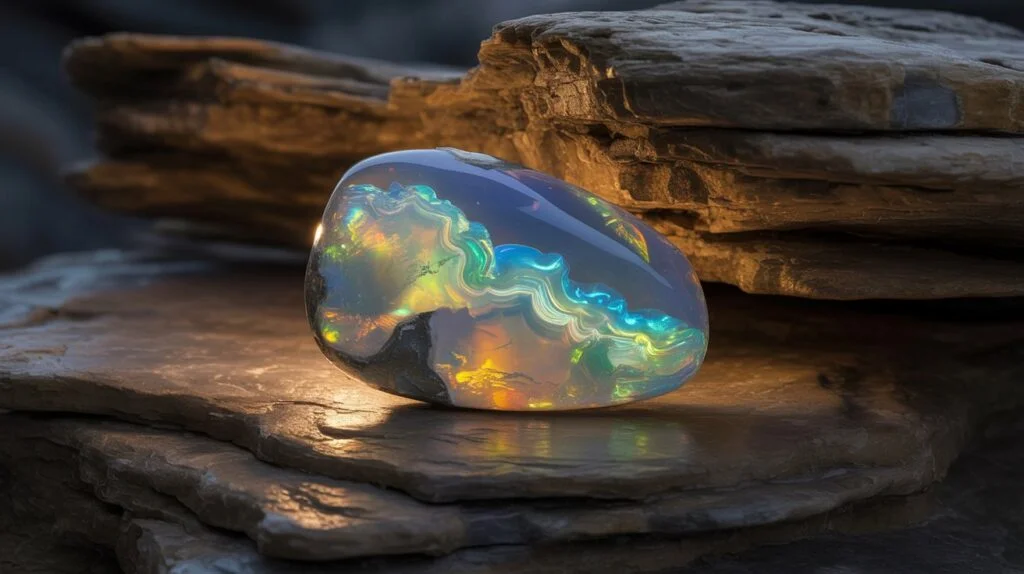
Deep beneath the Earth’s surface, where temperatures soar beyond imagination and pressure crushes everything into submission, something extraordinary happens. Carbon atoms, those building blocks of life itself, begin their transformation into diamonds. But every so often, an uninvited guest appears at this geological party. Boron, a rare element, infiltrates the crystalline structure, and the result is nothing short of magical: a Blue Diamond is born.
This isn’t supposed to happen. The conditions required are so precise, so unlikely, that finding these gems is like discovering a needle in a haystack the size of a planet. Yet here they are, scattered impossibly throughout the Earth’s mantle, waiting millions of years to make their journey to the surface.
The Color That Defies Logic
When you look at a blue diamond, you’re witnessing one of nature’s most beautiful accidents. The blue hue doesn’t come from pigmentation or coating. Instead, it’s the result of boron atoms absorbing red, yellow, and green wavelengths of light, allowing only blue to reach your eyes. It’s a phenomenon so rare that blue diamonds account for less than 0.1 percent of all diamonds ever discovered.
Think about that for a moment. For every thousand diamonds pulled from the earth, perhaps one carries that haunting azure shade. The odds make lottery wins look commonplace by comparison.
What makes this even more remarkable is that boron shouldn’t be down there at all. This element typically stays near the Earth’s surface, content to remain in the crust. For it to descend into the mantle where diamonds form requires tectonic plate subduction, a process that takes millions of years and involves entire sections of the ocean floor being dragged down into the planet’s interior.
A Journey Written in Geological Time
The story of how these stones reach us reads like an epic adventure spanning epochs. First, ancient seabeds rich in boron compounds sink deep into the Earth through subduction zones. These are the places where one tectonic plate slides beneath another, pulling surface materials down into the inferno below.
Once there, the boron encounters carbon under extreme conditions: temperatures exceeding 2,000 degrees Fahrenheit and pressure more than 725,000 pounds per square inch. Over millions of years, carbon atoms arrange themselves into the perfect cubic structure we recognize as diamond. When boron joins this party, it substitutes for carbon atoms in the crystal lattice, creating something that shouldn’t exist.
But the journey isn’t over. These gems must then hitch a ride back to the surface, typically through violent volcanic eruptions that bring them up through pipes of rock called kimberlites. The ascent must be fast, too slow and the diamonds would convert back to graphite. It’s a race against thermodynamics, and only the lucky ones make it intact.
Why Humans Can’t Resist the Blue
Our fascination with these stones goes beyond simple aesthetics. Throughout history, blue has been the rarest color in nature, associated with divinity, royalty, and the infinite. Ancient civilizations couldn’t easily create blue pigments. The sky and the sea teased humanity with a color that seemed perpetually out of reach.
When a stone contains that celestial shade naturally, locked within its crystalline perfection, it becomes more than jewelry. It becomes a piece of the impossible made tangible.
The Hope Diamond, perhaps the most famous blue diamond in history, carries with it centuries of obsession. Weighing over 45 carats, this legendary stone has passed through the hands of kings and thieves, surrounded by tales of curses and tragedy. But curses aside, what the Hope Diamond really represents is humanity’s endless quest to possess the rare and the beautiful.
The Modern Hunt for Liquid Sky
Today, mining companies employ sophisticated technology to find these treasures. Satellite imagery, geophysical surveys, and computer modeling help identify potential diamond-bearing kimberlite pipes. Yet even with all our modern tools, discovering a significant blue diamond remains an event worthy of headlines.
The Cullinan mine in South Africa has produced some of the world’s most exceptional blue diamonds. Australia’s Argyle mine, before its closure, occasionally yielded blue stones alongside its famous pink diamonds. These locations represent geological lottery tickets, places where the impossible alignment of conditions created something extraordinary.
When a significant blue diamond appears at auction, the world takes notice. In 2015, the Blue Moon of Josephine, a 12.03-carat stone, sold for over 48 million dollars. In 2016, the Oppenheimer Blue fetched more than 57 million dollars. These aren’t just prices; they’re statements about how much we value rarity and beauty combined.
What Science Reveals About Value
Gemologists can now analyze these stones with incredible precision. They can determine not just the presence of boron, but its concentration, the stone’s formation depth, and even estimate its age. Some blue diamonds formed over three billion years ago, making them nearly as old as life on Earth itself.
This scientific understanding hasn’t diminished our wonder. If anything, knowing the improbable sequence of events required to create these gems makes them more precious. They’re not just pretty; they’re geological miracles with resumes spanning billions of years.
The Future of Blue
As natural sources become increasingly rare, scientists have developed methods to create blue diamonds in laboratories. These lab-grown stones have the same chemical composition and crystal structure as natural ones. They’re real diamonds, just with a different origin story.
Yet the market clearly distinguishes between the two. A natural blue diamond commands prices that lab-grown versions cannot match. The difference isn’t in chemistry but in narrative. We value the journey, the improbability, the millions of years of planetary forces working in perfect concert to create something that shouldn’t exist.
Holding the Ocean
When you hold a blue diamond, you’re holding a compressed ocean floor, processed by geological forces beyond human comprehension, brought to the surface by volcanic violence, and cut by human hands to reveal its inner light. You’re holding evidence that our planet is constantly reinventing itself, that beauty can emerge from chaos, and that some of nature’s greatest masterpieces are born from the most unlikely circumstances.
That’s the real treasure: not just the stone itself, but the story it tells about our extraordinary planet and our equally extraordinary desire to find beauty in the rarest places.
Want more to read? Visit dDooks.
