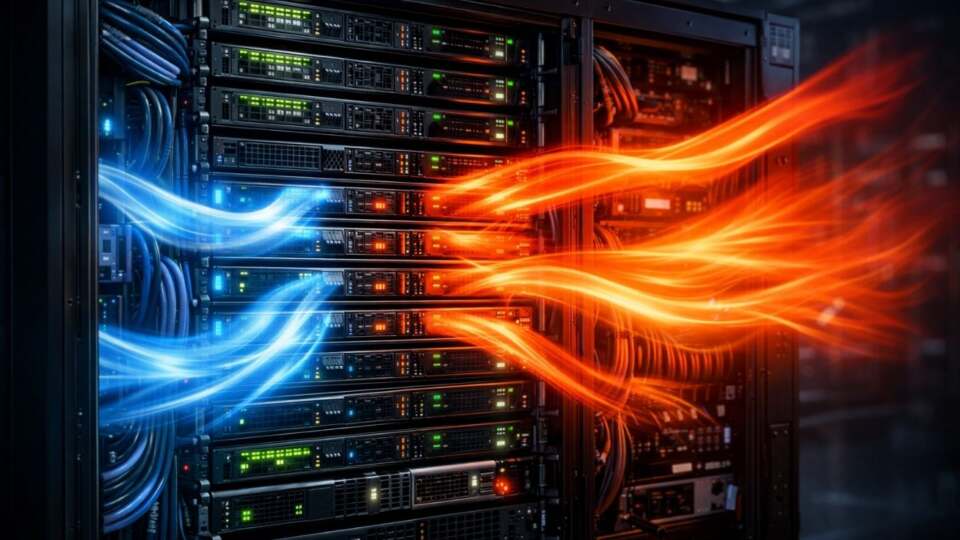
The hidden costs of overheating in industrial operations are staggering. Without proper heat dissipation, facilities face increased risks of downtime, severe hardware failure, and compromised data integrity.
As processing power and equipment density increase, passive airflow is no longer sufficient. Facility managers and IT engineers must adopt robust cooling strategies to maintain operational continuity.
This guide explores the fundamentals of thermal management, breaking down the hardware and best practices required to protect sensitive industrial and IT infrastructure.
Why Thermal Management is Critical for Industrial Equipment
Every active electronic component generates heat due to electrical resistance. In confined spaces like control cabinets and server racks, this heat accumulates rapidly.
When temperatures exceed safe operating thresholds, equipment experiences thermal throttling, a process where processors intentionally slow down to prevent melting. Constant exposure to excess heat severely degrades the silicon inside microchips.
Do Read: Eco-Conscious Solutions for Liquid Waste Challenges
Over time, poor thermal management drastically reduces the operational lifespan of expensive machinery. Proactive cooling is not just an operational necessity; it is a critical financial safeguard against premature equipment replacement.
Core Components of an Efficient Airflow System
Effective thermal management relies on choosing between passive cooling (relying on natural convection) and active cooling (using mechanical force to move air). High-density systems almost exclusively require active solutions.
When designing an active cooling architecture, engineers must select components that can withstand harsh environments. The foundation of these systems typically relies on industrial-grade AC and DC ventilation units.
For instance, incorporating highly durable ACDC FAN designed for server racks and intelligent manufacturing equipment ensures stable airflow and prevents system throttling even under maximum load.
Axial vs. Radial Cooling Fans
Selecting the right fan depends entirely on the specific application and airflow impedance of the enclosure.
- Axial Fans: These push air straight through their axis. They provide high airflow volume and are ideal for general server rack cooling where backpressure is minimal.
- Radial (Centrifugal) Fans: These pull air in and expel it at a 90-degree angle. They are engineered for high-pressure environments, making them perfect for dense control cabinets with heavily restricted airflow.
Best Practices for Server Rack and Cabinet Cooling
Optimizing hardware is only half the battle; the physical layout and organization of the equipment play a massive role in cooling efficiency. Implementing structured best practices ensures your hardware investments operate at peak performance. For insights on maximizing operational workflows, refer to this guide on business efficiency and hardware integration.
Implementing the Hot Aisle/Cold Aisle Layout
The hot aisle/cold aisle layout is a foundational strategy in data centers and large-scale industrial setups. Racks are arranged back-to-back and front-to-front.
Cold air is pumped into the “cold aisle” facing the equipment intakes, while the exhaust heat is expelled into the isolated “hot aisle.” This prevents the mixing of hot and cold air, maximizing cooling efficiency and reducing overall energy waste.
Managing Cable Clutter to Prevent Air Blockage
Unmanaged cables act as physical barriers, heavily restricting necessary airflow. When air cannot circulate properly, it creates dangerous localized hot spots within the cabinet.
- Use horizontal and vertical cable managers.
- Route thick power cables away from exhaust vents.
- Bundle and tie cables tightly to ensure unimpeded air pathways.
The Future of Industrial Cooling: EC Technology and Energy Efficiency
The push for sustainability is reshaping how facilities approach thermal management. Modern EC (Electronically Commutated) fans operate at much higher efficiencies than traditional AC motors.
These smart systems utilize integrated temperature sensors to adjust fan speed dynamically based on the real-time thermal load. Upgrading to smart industrial components is a key step in modernizing facility infrastructure, a topic thoroughly covered in our technology and hardware updates.
According to global energy reports, optimizing cooling systems can drastically reduce a facility’s overall carbon footprint and power usage effectiveness (PUE), a critical metric highlighted by data center energy efficiency standards for maintaining sustainable infrastructure.
Conclusion
Proactive thermal management is a fundamental requirement for any industrial or IT facility. By understanding the core components of airflow and implementing strategic layouts, engineers can completely neutralize the threat of overheating.
Investing in high-quality fans and adhering to modern efficiency standards not only prevents costly downtime but also guarantees maximum equipment longevity and sustainable operational success.
Want more to read? Visit dDooks