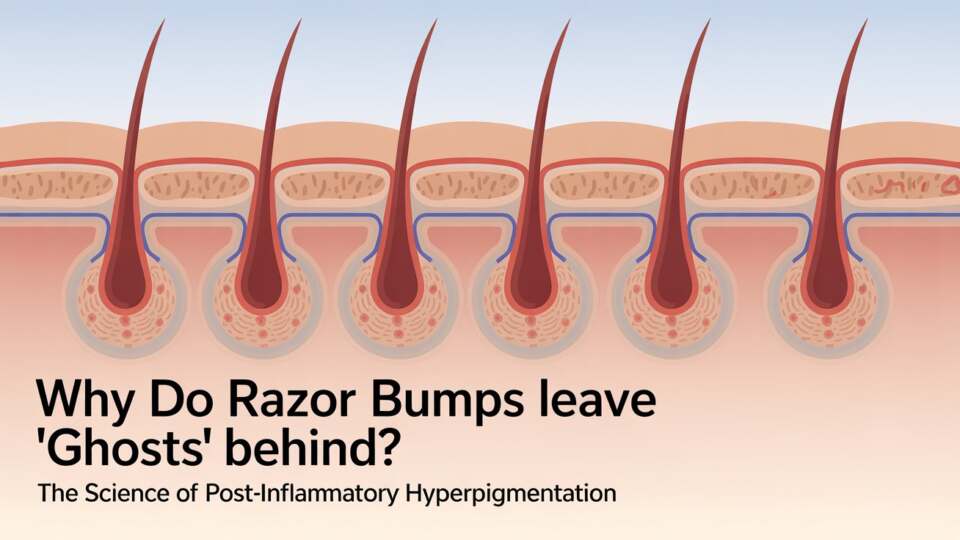
For millions of people, the ritual of hair removal is followed by a predictable and disheartening cycle. First comes the shave or the wax. Then, a few days later, the tender red bump appears—the telltale sign of an ingrown hair. But even after the hair is freed and the bump subsides, a stubborn reminder remains: a flat, dark mark that refuses to fade.
These “ghosts” of razor bumps past are medically known as Post-Inflammatory Hyperpigmentation (PIH). For many, particularly those with medium to deep skin tones (Fitzpatrick types III-VI), these dark spots are far more distressing than the hair itself. While a razor bump might heal in a week, the hyperpigmentation it leaves behind can linger for months or even years.
To truly treat this issue, we must stop viewing the dark spot as a separate problem. It is not a stain on the skin; it is a biological scar, a testament to a microscopic war that took place within the follicle.
The Anatomy of the Collision
To understand the ghost, we must understand the death of the bump. The technical term for chronic ingrown hairs is Pseudofolliculitis Barbae. It occurs when a hair, cut sharp by a razor, curls back and re-enters the skin (extra-follicular penetration) or fails to exit the follicle at all (trans-follicular penetration).
The body does not recognize this hair as “self.” It recognizes it as a foreign invader, similar to a splinter. The immune system immediately launches a defense. White blood cells rush to the site to attack the intruder, resulting in the classic symptoms of inflammation: redness, swelling (edema), heat, and pus.
Do Read: How to Choose the Right Dentist: What Questions to Ask
This inflammatory response is vital for fighting infection, but it has a messy side effect.
The Melanocyte Panic Button
Deep within the epidermis lie cells called melanocytes. These are the factories responsible for producing melanin, the pigment that gives skin its color.
Melanocytes are incredibly sensitive. When the skin becomes inflamed due to the trauma of an ingrown hair, chemical messengers called cytokines are released. These messengers inadvertently hit the “panic button” on the nearby melanocytes.
In response to the trauma, the melanocytes go into overdrive, pumping out excessive amounts of melanin granules (melanosomes) as a protective mechanism. It is a biological overreaction. Even after the inflammation dies down—after the white blood cells leave and the swelling stops—the excess pigment remains trapped in the skin cells. This is the dark spot.
The reason this affects darker skin tones more severely is simply a matter of volume. Darker skin has more active melanocytes. Therefore, the “overreaction” produces significantly more pigment, leading to darker, more persistent spots.
The “Pick” Paradox
The severity of PIH is almost always exacerbated by human behavior. When we see a bump, the instinct is to perform “bathroom surgery”—picking, squeezing, or digging with tweezers to free the hair.
While this might release the hair, it creates massive additional mechanical trauma. This amplifies the inflammatory signal sent to the melanocytes. Essentially, by picking at the bump, you are screaming at your pigment cells to work harder. A bump that might have left a faint, temporary shadow becomes a deep, dark lesion that lasts for a year.
The Chemical Solution: Dissolve, Don’t Scrub
The old-school approach to dealing with these marks was physical exfoliation—scrubbing the skin with loofahs or apricot pits. We now know this is counterproductive. Scrubbing causes friction; friction causes inflammation; inflammation causes pigmentation. It is a vicious cycle.
The modern dermatological approach relies on chemical exfoliation and tyrosinase inhibition.
- The Gatekeepers (BHAs and AHAs): To prevent the ingrown hair (the trigger), we need to keep the follicle clear. Salicylic Acid (a Beta Hydroxy Acid) is the gold standard here. Because it is oil-soluble, it can penetrate deep into the pore, dissolving the “glue” that holds dead skin cells together. This allows the hair to exit freely without curling back. Glycolic and Lactic Acids (Alpha Hydroxy Acids) work on the surface, polishing away the dead skin that traps hairs.
- The Pigment Blockers (Tyrosinase Inhibitors): To treat the ghost, we must tell the melanocytes to calm down. We do this by inhibiting an enzyme called tyrosinase, which is required to make melanin. Ingredients like Kojic Acid, Tranexamic Acid, and Licorice Root Extract work to block this enzyme.
When you combine these two mechanisms—exfoliating the dark surface cells while simultaneously blocking the production of new pigment—you accelerate the fading process safely.
The Role of Consistency
The most difficult aspect of treating PIH is patience. The skin cell turnover cycle is roughly 28 days, and it slows down as we age. Fading a deep spot requires multiple cycles of turnover.
There is no overnight eraser. However, the dual-action approach—preventing the trauma of the ingrown hair while chemically treating the pigment—is the only way to break the cycle.
This is why specialized formulations have become so popular. Products that combine anti-inflammatory agents with exfoliants and skin brighteners, such as various PFB ingrown hair solutions, are designed to address the entire timeline of the problem: the pre-shave clog, the active inflammation, and the post-healed shadow.
Conclusion
The “ghosts” on our skin are not permanent. They are simply evidence of a confused immune system. By understanding the biology of inflammation and respecting the sensitivity of our melanocytes, we can trade the tweezers and scrubs for intelligent chemistry. The goal is not just a hair-free surface, but a quiet one—where the skin is calm, the barrier is intact, and the history of every shave doesn’t leave a mark.
Want more to read? Visit dDooks.