


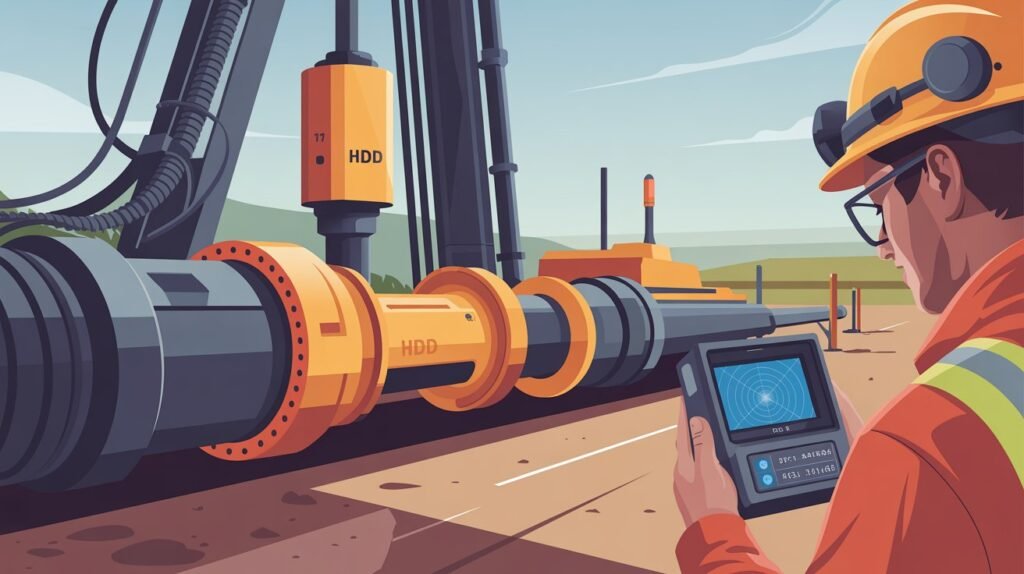
Most HDD contractors do not run a brand-new guidance fleet. They run what has proven itself. That usually means a couple of legacy Subsite locators that have already paid for themselves many times over, plus newer gear for the really complex crossings.
Those older Subsite systems are not the problem. The real trouble starts when the beacon strategy behind them is just “whatever is in the box today”. Depth jumps, signal fades near the edge of range, and an easy day turns stressful for no good reason.
This guest post is about turning that chaos into a simple, repeatable plan built around two clear roles: one compact everyday beacon and one deeper-reaching option for tougher work.
Legacy Subsite locators still have a job
It is tempting to think that any equipment that is not the latest model should be replaced. But look at the jobs your legacy Subsite rigs actually run:
- Short and medium service shots into homes and small businesses
- Utility and fiber runs along streets and sidewalks
- Crossings under local roads and driveways
- Light commercial relocations with room to correct if needed
These are not 400-meter river crossings. They are the kind of bores that keep crews busy and invoices going out. In this work, the locator rarely holds you back. The weak link is almost always the beacon in the head – its condition, suitability and consistency.
If you want those Subsite systems to feel solid again, the first step is to stop treating beacons as random consumables and start giving each one a clear job.
The compact everyday workhorse
Most of your Subsite bores do not need maximum range. They need a beacon that is:
- Small enough to fit common housings without weird adapters
- Simple to power, with predictable battery life
- Stable at the depths and distances you actually drill most often
That is the natural niche for a compact workhorse model. Many fleets quietly make this their default choice: when nothing in the drawings looks unusual, this is the beacon that goes in the head.
A good example would be standardizing your everyday Subsite rig around a proven compact unit like a 17t1 beacon. When you do that, a few things fall into place:
- Housings are matched to one body length and diameter, so assembly is quick and repeatable.
- Battery type is no longer a debate at the truck door. Everyone knows what to pack.
- Locator hands get used to one “feel” for the signal, so they notice problems early instead of blaming the ground.
The goal is simple: make 70–80 percent of your jobs feel routine because the locator and beacon combo is always the same, and it is always suited to that class of work.
When you need more reach and confidence
Of course, not all bores are modest. Even older Subsite setups are sometimes asked to handle:
- Slightly deeper road or parking lot crossings
- Longer pushes across open ground
- Areas with more steel, thicker slabs or a little more electrical noise
On these days, the compact workhorse beacon can start to feel like it is working at the edge of its comfort zone. You still have signal, but the locator hand has to work harder for it.
This is where a deeper-rated, stronger beacon earns its place. Compared to the compact unit, a long-range or higher-power beacon typically offers:
- Stronger, more stable readings at greater depths
- More forgiving behavior near the edge of range
- Extra headroom when soil or interference is slightly worse than expected
In many fleets, that role is filled by a beacon in the 88B class. Treat a deeper-rated unit like a dedicated tool for tougher shots, for example a subsite 88b beacon, and make it part of your pre-job planning instead of something you only reach for after problems start.
Simple rules that remove guesswork for the crew
The whole point of having two clear beacon roles is to get rid of “pit-side decisions” made in a hurry. You do that with a few written rules that everyone understands:
- If the bore is within a defined maximum depth and length, and there is no unusual interference in the plan, default to the compact everyday beacon.
- If the bore exceeds that depth or length, or passes under thicker pavement, larger roads or known “noisy” corridors, upgrade to the deeper-rated beacon from the start.
- In both cases, the truck carries a tested spare of the same model, clearly labeled and ready to swap in.
With that in place, the locator is not standing at the entry pit wondering which beacon might work today. The choice was made during planning, based on numbers, not gut feeling.
Managing beacons as inventory, not as a junk drawer
Even with a “two-beacon strategy”, things fall apart fast if you do not know what you actually own. A simple inventory system helps more than most people expect:
- Each beacon gets logged by model, serial and condition.
- You note which rigs it usually supports and which jobs it has recently worked on.
- You mark units as “primary”, “backup”, “testing needed” or “training only”.
This can be as simple as a shared spreadsheet. The important part is that when a crew leader signs out gear for the day, they are not guessing which beacon is trustworthy. They can see at a glance which units are ready for field work and which need time on the bench.
Refurbish, rotate, retire
Buying all new is not the only way to keep beacon quality high. A lot of value can be extracted from your existing pool if you deliberately:
- Refurbish solid units that are starting to show age but still test well with pressure checks, seal replacement and calibration.
- Rotate refurbished beacons into everyday roles while reserving your very best units for deeper or higher risk work.
- Retire beacons that repeatedly show unstable behavior to training duties or test pits instead of sending them out on revenue jobs.
The key is to connect those decisions to your inventory log so you always know how many healthy, field-ready beacons you have in each category.
Field habits that protect every beacon you own
No planning can save hardware that is abused every day. A few simple habits will dramatically extend the life of both your compact and deep-range beacons:
- Clean threads and sealing faces before you open or close housings so grit does not shred o-rings.
- Replace seals that look flattened, cracked or shiny instead of trying to get “one more job” out of them.
- Keep battery compartments dry and corrosion free, and never mix old and new cells.
- Store beacons in padded cases, not loose in steel toolboxes or on truck floors.
- Tag any unit that starts giving erratic readings and bench-test it before sending it back out.
These are not glamorous steps, but they are exactly what separate fleets that are “always fighting the signal” from those where guidance quietly works in the background.
Want more to read? Visit dDooks.
